We hold these truths to be self-evident that not all energy sources are created equal

Yesterday morning, I went to a press conference hosted by Clean Energy Works. I knew there would a variety of speakers but I didn’t expect was to be blown away by the words of two young women, both in high school at the Maggie L. Walker Governor’s School. I should have expected it.

As Callie Guy, a senior, pointed out to the crowd, “For my generation, the controversy over global climate change simply doesn’t exist. We know what the price of inaction is, and it will fall on me and my friends unless we act now. It is time for my generation to declare their independence from the fossil fuels of the past and lead our country on a clean energy revolution. “

Callie’s right. My generation has moved past deciding if global warming exists to deciding how to solve it. We refuse to listen to false solutions such as clean coal and nuclear. My generation will Define Our Decade with 100% truly clean, safe, green energy.

Maggie Chambers, a junior, closed the press conference with these words which I want to share with all of you.

“We hold these truths to be self-evident that not all energy sources are created equal, that all people are endowed with the undeniable rights to clean air, liberation from foreign oil, and the pursuit of permanent clean energy jobs- That to secure these rights, Government should follow the path of pursuing strong clean energy and climate legislation

LTE: Make it CLEAR

Chris Llewellyn is an amazing climate activist from Williamsburg. She was our CCANer of the Month back in June of 2007, which prompted me to go back and find that archived newsletter. Just a quick side note: It’s pretty amazing how far CCAN’s e-newsletters have come.

More importantly, I wanted to share her letter to the editor of the Daily Press about the Cap-and-Dividend solution, which was published earlier this week. Check it out below:

Make it CLEAR

BY Chris Llewellyn
Daily Press
March 8, 2010

Despite what our state attorney general says, the science is clear

This just in: Restaurant Nora to Cater "Artists for the Climate" Reception

I am thrilled to announce that Restaurant Nora — one of DC’s most famous eateries and America’s first certified organic restaurant — will cater a special reception from 6-7 PM as part of CCAN’s Artists for the Climate event.

Their participation was just finalized and you’re the first to find out about it.

Owner Nora Pouillon will prepare a range of delectable appetizers and refreshing organic beverages to help honor authors Bill McKibben, Jeff Biggers, and Mike Tidwell.

For a donation of $150 dollars, you will enjoy some of the city’s absolute best food and have the opportunity to personally meet the authors. In addition, you will receive your choice of two free, autographed books from the featured writers.

Forty front row seats will be set aside for our reception guests. Space is limited to 40 guests so get your tickets now!

Daily Scandal: Free Big Coal Window Ads in Inhofe and Senate Enviro Committee Office?

This is cross-posted from huffington post.

While the US Senate Committee on Environment and Public Works is charged with protecting “the air we breathe, the water we drink, and the products we consume have a direct impact on the health of our families,” some of its staffers apparently feel it should also serve as a front for the devastating pollution of Big Coal.

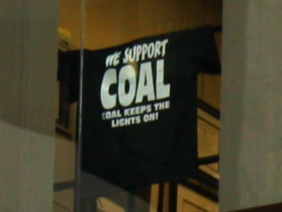
As hundreds of citizens from ravaged coalfield areas in Appalachia and around the nation fill the corridors of Congress this week, calling on the House and Senate to pass the Clean Water Protection Act/Appalachian Restoration Act to stop the illegal dumping of toxic coal waste into our American waterways, Sen. James Inhofe (R-OK) and his staff on the Senate Environment and Public Works Committee are reportedly providing free window space for Big Coal ads in our taxpayer financed federal buildings.

Check out this photo of the Senate minority leader’s office window at the E/PW Committee, sent by concerned coalfield residents from West Virginia, who have repeatedly asked the staffers to take down the offensive T-shirt on government property:

2010-03-10-Picture5.png

2010-03-10-senate2.jpg

While Sen. James Inhofe’s comments on climate change are legendary, his prairie land and plains state support for flattening Appalachia through devastating mountaintop removal mining is dangerously uniformed. Last spring, Inhofe sent a letter to EPA chief Lisa Jackson, charging her agency for delay in issuing Clean Water Act permits. Inhofe erroneously claimed:

“As you know, mountaintop mining is a vitally important economic activity. It provides a significant portion of the coal that contributes nearly 50 percent of the nation’s electricity. It also provides well-paying jobs and revenues for some of the neediest regions.”

Significant portion of coal?

Setting aside the reality that mountaintop removal’s irreversible destruction has eliminated over 500 mountains and nearly 1.2 million acres of hardwood forests in the carbon sink of America, led to the largest forced removal of American citizens since the 19th century, and jammed an estimated 2,000 miles of headwater streams and waterways with toxic coal waste, Inhofe’s distortion of the true cost of coal and his window dressing for Big Coal overlooks four main points:

1) As everyone else on the Senate Environment and Public Works Committee does know–or should know– mountaintop removal mining provides less than 8 percent of all national coal production.

2) Mountaintop removal has bled the Appalachian economy and job market. As the recent study, “The Decline of Central Appalachian Coal and the Need for Economic Diversification,” makes clear:

Despite these economic benefits, coal-producing counties in Central Appalachia continue to have some of the highest poverty and unemployment rates in the region, and due to the dependence on coal for economic development, any changes in coal production will have significant impacts on local economies.

Specifically, a study last year by West Virginia University reseachers found:

The coal industry generates a little more than $8 billion a year in economic benefits for the Appalachian region. But, they put the value of premature deaths attributable to the mining industry across the Appalachian coalfields at — by a most conservative estimate — $42 billion.

And check out West Virginia blogger Clem Guttata’s analysis of the economics of mountaintop removal on the heels of Inhofe’s misinformed comments.

3) Even the most pro-coal legislators in Appalachia and on Capitol Hill recognize that Appalachian coalfields and across the country are facing a clock of peak coal, and need to shift toward a just transition for clean energy jobs and economic development.

4) Sorry Sen. Inhofe: Coal-fired plants provided only 45% of our electricity last year, and it’s declining.

You can let Sen. Inhofe and the Senate Committee on Environment and Public Works, as well as all members of Congress, know what you think about public financing for Big Coal and misinformation here.

Avatar: the Problematic Environmental Blockbuster

While visiting my parents recently, my mother treated me to a 3-D showing of Avatar at a theater close to where I grew up. I went in with a fair amount of trepidation. I’ve been following the media coverage of the film, as well as conversations between friends and colleagues who had seen it in the weeks follow its premiere. I was feeling very nervous about the racial dynamics of the film, and though I’d heard many people describe the film as very pro-environment, I wondered how pro-environment a blockbuster movie could be; how much can its themes and messages really challenge the status quo of our fossil fuel-powered society?

After two and a half hours of pure visual spectacle, I left feeling a mix of emotions and with a ton of thoughts running through my mind. I felt angry. I felt very angry.

I felt angry that the Na’vi people needed an American to save them. I felt angry that the Na’vi people needed an American to save them from Americans! I felt angry for the truth at the heart of the action: the single-minded focus on profits over people and the environment, and the price indigenous people have paid for centuries.

The single most impactful moment for me was when the Head of Security, Colonel Quaritch, said

Our neighbors in Appalachia are all too familiar with the impact destruction can have on a culture and community. Mountains that were once home to cemeteries and burial sites with generations of a single family have been blasted away. What can root someone to a place more than knowing that his or her family lived and died there? Yet coal companies feel a few thousand dollars and paying below-market price for one’s home is just compensation. In Avatar, RDA Corp. felt that building a few schools and bringing vaccines would ingratiate them to the Na’vi. Schools and vaccines in exchange for your ancestral home and livelihood. Not quite a fair exchange.

In addition to processing my anger, I was also interested in asking my mother what she felt about the movie’s messages. In many ways, my mom represents her demographic well: married women in their late 40s and early 50s, working again, concerned about the economy, leaning right or solidly right in her politics. This is quite representative for the suburban Atlanta area where my parents live.

What did she think of the mining scenes: the endless, violent quest for energy sources? The corporate exploitation of another planet, and another people? She didn’t like any of these things, but here’s the kicker. When I asked, did the events of the film connect with anything happening in the world or United States today?

The answer: Nope. To be honest, my mother admitted not being very familiar with Mountaintop Removal mining, or Tar Sands mining in Canada. She felt strongly that what RDA Corp. was doing was wrong, but was unable to connect it to her life, or to our neighbors to the north. To me, this is the tragic failure of Avatar.

The parallels between Avatar and Mountaintop Removal are obvious. Other bloggers have also done great work drawing the parallels between Ecuador, Nigeria, even to the Disney version of the Pocahontas story (www.itsgettinghotinhere.com for starters). There are numerous scenarios to draw parallels from because the general arc of the story is so identifiable, so repeated across world history. The basic story is this: a multi-national, or in this case, multi-planet, corporation finds a valuable natural resource deposit near or in an area occupied by an indigenous community. The corporation tries various ways of “negotiating” with the locals, but ultimately ends up using violence and Western weaponry to take the resources by force. Perhaps there is a cultural go-between working the lines; someone from the colonizing culture who becomes familiar with the indigenous culture. This person will sometimes learn the value of the indigenous culture, and perhaps try to show the colonizers the error of their ways. In the end, it always ends the same, at least in real life.

The unique angle Avatar has is its focus on the natural resource being an energy source. Unobtanium looks remarkably like coal, but is much more expensive and small amounts can be burned to create huge amounts of power. To get to the unobtanium, the corporation must use equipment and processes that look remarkably like those used in Mountaintop Removal mining in Appalachia or in Tar Sands mining.

This film is also unique in how the indigenous culture triumphs over the colonizers. However, they don’t do it alone. In Avatar, the deity, Eywa, unites the planet of Pandora against the invaders, mobilizing all the planet’s different creatures, large and small, in the fight to preserve the planet. This could be an apt metaphor for Climate Change. Is the Earth signaling her alarm system? Telling us we’ve gone too far, and if we don’t retreat, rethink, and rehabilitate our ways, there will be significant human costs?

In addition to being the highest-grossing film in the history of film, Avatar is getting so much attention in the press for a couple of reasons. It was a huge financial gamble for Director James Cameron and the studio. Avatar is nominated for Academy Awards for Best Picture and Best Director, and it has also inspired tremendous international activism around environmental issues and human rights abuses. A few weeks ago, Palestinians dressed up as Na’vi people, drawing a comparison in their struggles against Israeli occupation of Palestinian land. Indigenous communities in the US and Canada have also compared the struggle of the Na’vi people in the film to their own lives, especially as the United States government has a long history of extracting valuable resources and fossil fuels from sovereign Native American land.

The 82nd Annual Academy Awards aired last night, and Avatar did not win Best Director or Best Picture. Avatar won a handful of awards for its technical achievements, which are well deserved. Had Cameron made it to the stage to accept an award, there would have been a lot riding on his statement. He recently claimed he is the greenest director of all time at a recent NRDC event. The quotes are captured in a write-up on Grist.org, here.

Had James Cameron won, I know what should have been in his acceptance speech: the recognition that the story of Avatar is hundreds of years old, and is being repeated with a slightly different cast every year, all across the Globe. Americans need to wake up, and realize the alarm is sounding. It’s time to act.

The team who won Oscars for Best Art Direction got close, saying “Avatar is a film about learning to see the world in new ways.” Winner Joe Letteri also said, “And just remember the world we live in is just as amazing as the one we created for you.” Not quite as direct as I would have liked, but it’s a start.

The Scars on Our Mountains

Thanks to the constant updates via my Twitter feed, this week I discovered NASA’s Earth Observatory website. This website shows satellite images of the Earth — many tragic (arctic sea ice), some providing glimpses of hope (burn recovery in Yellowstone) and some simply bizarre (the growth of Dubai.) Perusing the images and attempting to interpret the changes from image to image was intriguing until the time lapse of mountaintop removal stopped me completely. I no longer marveled at the ability to capture such images, I was sickened at what we are doing to our mountains in Appalachia. I’ve seen mountaintop removal sites in person, but these images clearly show the scale and the permanence of the destruction.

According to the website:
“Below the densely forested slopes of southern West Virginia’s Appalachian Mountains is a layer cake of thin coal seams. To uncover this coal profitably, mining companies engineer large

Get in the Game Senator Mikulski

Here’s a question: If you’re a legislator and you voted to strengthen a particular piece of legislation, and that piece of legislation later came under threat, wouldn’t you make an effort to protect it? The answer seems logical enough, but then again, as we all know, everyday logic doesn’t always apply to the world of politics.

How else would you explain Maryland Senator Barbara Mikulski’s failure stand up to protect the Clean Air Act from the attacks that it’s recently come under from the likes of Lisa “Dirty Air” Murkowski? After all, as the Senate’s Legislation and Records site shows, Senator Mikulski voted for the 1990 amendments that strengthened the original 1970 Clean Air Act, ensuring that it had the teeth it needed to really bite into problems like acid rain. But now when opponents of climate action are trying to knock those same teeth out, Mikulski is standing on the sidelines. Continue reading

NoVa Climate Activists Unite!

This past Saturday, over 75 climate change activists in Northern Virginia came together for the Northern Virginia Climate Action Network’s Tools for Change III: Energy Efficiency, Bringing the Message Home and Skills Training. Attendees came from across NoVa, from Loudoun to Bristow, with the common goal of learning more and getting involved in the fight for federal climate change legislation.

Speakers presented on a range of topics focused on some of the federal legislation in the Senate right now, as well as more local successes and projects in the works. Elenor Hodges, Executive Director of Arlingtonians for a Clean Environment, talked about the Green Living Challenge.