‘Hill Rapid Response Force’ in Action

ethan Posted by ethan on 02 Jul 2009 | Tagged as:

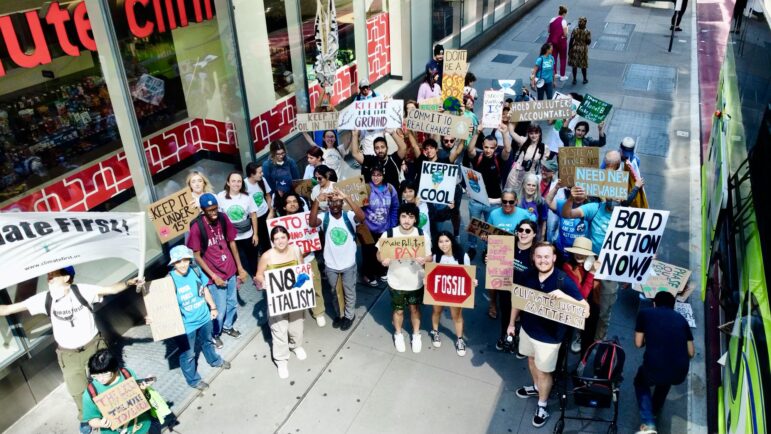
Last Friday CCAN rallied over 100 people outside the US Capitol Building as members of Congress were about to vote on the ACES bill. (A bill that sadly falls short of securing our future). CCAN joined hands with the Energy Action Coalition, the Avaaz Action Factory, and Campus Progress to boldly say: “WE NEED MORE: Pass a STRONG Clean Energy Bill.” After the rally we marched around the three House office buildings carrying signs and model wind turbines. Check out the video and the picture in the Wall Street Journal article. After our outside antics in the sweltering heat we went inside (to cool off) and really ‘do democracy’. We were an active presence in the halls and engaging members as they headed to the House Floor to vote. It is moments like these that I feel the old rally cry “this is what democracy looks like” is truly actualized.

Rally Pic in Wall Street Journal

Rally Pic in Wall Street Journal

We must be seen! We must be heard!

It is critical that we are visible and at the very least present on Capitol Hill. At the outset of the House Energy and Commerce hearings, where the ACES bill began, my eyes were first opened. You always hear about political corruption and the shortcomings or our representative democracy… but then to actually SEE IT with your own eyes is a radicalizing experience. There outside of the Energy and Commerce committee room you can actually SEE the dirty energy industry lobbyists circling outside the door to the hearing room like sharks. So we did the same thing and did ‘people’s lobbying’ in the halls.

The other major barrier to democratic access is the paid line-standers. No joke, there are people paid about $12 an hour by the industry lobbyists to stand in line up to 24 hours before the hearing even starts. Then 10 minutes before the hearing the corporate suits walk in and take their place in line. Many of us got there at 6AM and still were denied access to the hearing room because the lobbyists took all the seats. This system is a sad metaphor for the current state of American politics. You have to pay to play. You can’t even enter the democratic sphere or room (where your future is being decided!) unless you have enough money. And oh yeah, the more cash you have the more access you are granted.

I was pleased to see CCAN members and young people in Power Shift shirts and green hard hats say NO to this corruption. On multiple occasions we turned out in droves and flooded the “public” hearings with green shirts and green hard hats and demanded a better future and a better democracy. This is people power in its purest form, and I personally believe it is one of the most strategic uses of our power. We have the right to talk to our elected officials without a filter. We have the right to be physically present when our future is being decided.

The Fight Goes On! Next Tuesday morning the Senate Environment and Public Works Committee begins hearings on the Senate version of the ACES bill. (Senator Cardin of Maryland is on this critical committee). Will he and the other committee members listen to the voice of the people and the scientific community to make the bill stronger? Let’s not wait to find out. Let’s make it happen!

Sign up for CCAN’s “Hill Rapid Response Force list” and get the breaking news on what is happening on Capitol Hill and how you as a citizen can insert yourself and the voice of the people into this debate.

A New Day is Coming

MarcSO Posted by MarcSO on 02 Jul 2009 | Tagged as: Tags: ,

Our group decided to move our presence into the Longworth House office building to find as many representatives as we could to show them we want green jobs and clean energy. Making our way through security and downstairs to the basement one of my fellow group members asked me what we should be doing. Beginning to answer her question I spotted my Representative, Dr. Steve Kagen, hurrying past me. I informed my group member to hold that thought and I went after my Representative.

On Friday June 26, 2009, I took part in a collaborative rally on Capitol Hill. The groups who sponsored the rally included the Energy Action Coalition, Avaaz Climate Action Factory, and the organization I intern for, the Chesapeake Climate Action Network. The rally was sparked by the American Clean Energy and Security Act, which the House of Representatives were planning to vote on that evening.

Arriving at the site where the rally was being held, an image of PowerShift flashed before my eyes. The presence of green shirts and hard hats, Capitol Hill in the background, and the energy of people coming together to affect change. The only thing missing was weather I could handle. Being from Wisconsin, I like summer weather that has just a touch of cold. Since I’m in Washington, DC, the weather is unbearable for me. I decided to take refuge under a tree and watch the rally unfold before my eyes.

During the rally, the speakers spoke of the American Clean Energy and Security Act as a start towards what we want, but we need more from our elected officials. And that is something I agree with. We need a stronger bill. The rally came to a close and the speakers asked the crowd to stick around to make our presence felt through the halls of Congress. And our presence was felt. Continue Reading »

ACES Ambivalence Disorder

Keith Posted by Keith on 01 Jul 2009 | Tagged as: Tags: , , , ,

ACES-Ambivalence

So the US House of Representatives passed the American Clean Energy and Security Act on Friday. Given that many of us in the climate community have been griping for months on end about what a compromised, watered down, insufficient, coal friendly, piece of corporate welfare that the bill is, many of you may be wondering how you’re supposed to feel about this. Should we jeer or cheer? Should we do like Al and celebrate the mere passage of a climate bill as an historic achievement, or make like Greenpeace and raise our fists in protest against this flawed product of a hobbled political system?

If you’re ambivalent, that’s okay. Torn is exactly how you should feel about this bill. You’re just experiencing a very common condition I like to call ACES Ambivalence Disorder (AAD). Symptoms include irritability, frustration, dissatisfaction, anger, resentment, and political disillusionment on the one hand, and on the other a vague sense of hope and relief that the government is finally, actually, incredibly doing something (and may do more if only we push them).

If you peruse the array of statements many environmental orgs and yea-voting reps released after the ACES vote, you’ll find that most of the authors have been stricken with AAD as well. Just consider this press release from 1Sky, entitled “1Sky is Relieved by House Victory on Energy Bill; Ready to Work for More.” We feel you 1Sky. Or, kind of. I think.

We at CCAN are not entirely immune either. On Friday after scrambling (successfully!) to get MD Congressmen like Frank Kratovil just to vote yes on ACES, I joined Mike Tidwell, Jesse Tolkan and over a hundred climate activists on the east lawn of the Capitol to demand that Congress give us more.

So, again, to all you suffering from AAD, fear not. It’s perfectly normal. You’re in perfectly good company.

And best of all, there’s a cure. And you can be part of it. Here’s how: finish reading this blog, go directly to your phone and call Senators Cardin and Mikulski to let them know how you feel. Tell them that for starters what we need to help us all feel better about the bill and alleviate our AAD is the restoration of the EPA’s authority to regulate emissions from coal-fired power plants, and a huge dose of their leadership. For the full prescription check out Mike Tidwell’s recent letter.

Here’s to our speedy convalescence.

EPA Releases locations of 44 “high risk” coal ash impoundment sites.

Peebles Posted by Peebles on 30 Jun 2009 | Tagged as:

EPA LogoYesterday the EPA performed a turn-around on its protection of the locations of 44 “high risk” coal ash impoundment sites, signaling a desire to make the regulatory body more transparent.

Formerly protected under the auspices of national security, the ash impoundments, located in Ohio, Arizona, and throughout the southeast, have been determined to be particularly vulnerable to failure. In a time where the future of American energy remains stuck between antiquated fossil fuels and cleaner, renewable technology, concerns over proper disposal of coal ash has risen to the top of the debate, particularly after last December’s TVA sludge disaster in Roane County, Tennessee.

The reason behind this concern is, of course, fairly easy to identify. Coal slurry ponds, which may hold several billion gallons of the toxic sludge, are typically held in place by earthen dams made of rock and other fill material. While typically sturdy, history has shown us that these dams are definitely prone to failure, especially when not regulated properly. In fact, the dangers surrounding slurry dams have been well known and well documented for decades. West Virginia’s Buffalo Creek Flood of 1972 destroyed over 500 homes with a 30-foot high, 132 million gallon wave of the toxic stuff. When blasting occurs near these ponds (as it does near Marsh Fork Elmentary in Sunrise, WV), the risk becomes intensified as nearby shockwaves may threaten the structural integrity of the dam.

Marsh Fork Elementary

Fly ash, though dry and therefore less at risk to flooding, presents just as serious a hazard to the local ecosystem, including surrounding communities, wildlife, and groundwater reserves. Fly ash is stored in landfills, most of which are lined, but all of which are failure-prone. Particles in the air, blown from these ash impoundments, can cause serious health problems such as asthma and other respiratory diseases. Like wet slurry, fly ash contains a cocktail of harmful heavy metals and other contaminants that present a serious threat to the local and regional ecosystem… and to human health.

“CCRs [coal combustion residues] contain a broad range of metals, for example, arsenic, selenium, cadmium, lead, and mercury, but the concentrations of these are generally low. However, if not properly managed, (for example, in lined units), CCRs may cause a risk to human health and the environment and, in fact, EPA has documented cases of environmental damage“ (courtesy EPA.gov).

The collection and storage of coal ash is but one piece in a larger fossil fuel regime that thrives on the continued exploitation of the United States’ natural, non-renewable resources, known to cause significant air pollution and contribute to global climate change. The coal extraction, combustion, and disposal process is among the most destructive practices in human history, and with the continued popularity of mountaintop removal mining, the coal industry goes so far as to threaten the geography of Appalachia itself.

The EPA has made positive steps in naming these so-called high-risk sites, but seems to be avoiding tackling the bigger picture; coal is an unsustainable resource that is dirty, harmful, and dangerous. While 44 of these impoundment sites may be deemed more at-risk than others, the fact remains that anywhere coal is extracted, burned, or stored, safety is a non-issue, because coal is not, and never will be, “safe.”

President Obama, who has so far struggled with fulfilling his promise of increased transparency and accountability within government, has made significant forward progress by allowing the release of these 44 sites. However, the larger issue of formulating an American energy future – one without coal – rests untackled. As long as coal is allowed to thrive in Appalachia, the Midwest, and elsewhere, American citizens will remain at risk. The fossil fuel industry represents an old and outdated way of thinking: the idea that our actions now will bear no consequence on the future. We have now stepped healthily into the 21st century, largely thankful to the energy that fossil fuels of yore have given us, and as we continue to evolve as a species and a society, we are charged with abandoning a tradition that will serve no other end but to continue to harm Americans.

To President, Obama, Congress, and the EPA, if we are to bring the United States into a clean energy future, one that emphasizes the importance of renewable technologies, green jobs, and energy that is free of filthy, harmful substances, then we must see a real effort to focus on goals that do not give coal a future in the grid. The EPA seems to think that the term, “high risk,” should be reserved for a mere 44 out of the hundreds of slurry ponds and fly ash fills that sprinkle the American landscape. A more appropriate move would be to extend the “high risk” moniker to its proper breadth, across the entire industry.

Navigating a Minefield Part 1

Matt Dernoga Posted by Matt Dernoga on 30 Jun 2009 | Tagged as: Tags: , ,

minefield Navigating a Minefield Part 1

Cross-Posted from: HERE

I’m pretty sure that from now until the Senate votes on a climate bill, Senate Majority Leader Harry Reid will look at what he’s going to have to do to get 60 votes for a measure, and add 30 seconds to his schedule every day where he takes a pillow and cries into it. The Senate is where legislation goes to die. As elated as I was at passing the Waxman-Markey bill out of the House, it hit me pretty fast that this was going to get ugly.

Environmental groups have been talking about the idea of strengthening, but in the Senate what kind of grassroots pressure and mobilization would that really take? What kind of bill would we end up seeing if we had “business as usual” activism on this bill? The first thing I want to do is talk what is necessary for a much stronger bill, and I must admit that this has long odds considering we came up short in the easier of the two chambers. Next, I’m going to show you what compromises would have to be included in the bill in order to reach 60 votes assuming the level of support by the American public is as dull as it was in the House. Continue Reading »

We Need More

anne Posted by anne on 29 Jun 2009 | Tagged as: Tags: , ,


Video by Jay!

On Friday the American Clean Energy and Security Act passed 219-212 in an historic vote, but key features of the bill fall far short of what scientists say is urgently needed. The Senate, with President Obama’s leadership, must work to greatly improve the bill.

Waxman-Markey Passes House 219-212!

Matt Dernoga Posted by Matt Dernoga on 26 Jun 2009 | Tagged as: Tags: ,

pass Waxman Markey Passes House 219 212!

Cross-Posted from: HERE

Wow, one hell of a day! I was in DC for most of the hours of the day with many other youth(and a few older) climate activists rallying around climate legislation with the chant “we want more!”, to having a presence in the halls of Congress with the green shirts, to engaging Congressmen as they walked to the gallery, to attending the gallery to watch the vote. Time for an outburst…MAN AM I PUMPED. Here are the results of the vote.

I’m pretty exhausted, but I want to make a few comments and observations before passing out. I will add more depth to some of these later on. Continue Reading »

What really happened in Bonn?

Mike Tidwell Posted by Mike Tidwell on 24 Jun 2009 | Tagged as: Tags: , , ,

In our “Countdown to Copenhagen” weekly radio feature, Earthbeat Radio this week interviewed three leading U.S. policy advocates just back from the Bonn climate talks. What sort of leadership did the Obama team show in Bonn? How is the Waxman-Markey bill affecting the road to Copenhagen? Is the White House doing enough at home and aboard? Get answers from Angela Anderson of USCAN, Lou Leonard of WWF, and Karen Orenstein of Friends of the Earth.

Visit www.earthbeatradio.org and just click on “Listen Now.” You can also sign up for our weekly podcast to get the only weekly radio program in America dedicated exclusively to the climate crisis. This week we also look at “managed relocation” of plant and animal species due to climate change and we interview the world’s largest wind turbine company: Vestas of Denmark.

Flashmob in Capitol Hill cafeteria

anne Posted by anne on 24 Jun 2009 | Tagged as: Tags: ,

Forty flashmobbers, including CCAN’s own Kat McEachern, froze for 2 minutes in frustration over the lack of progress on climate change legislation. The action took place in Longworth Congressional Office Building’s Cafeteria during lunch time.

This action was organized through Craigslist and Twitter and called for a stronger “American Clean Energy and Security Act.” The bill is expected to come to a vote on the House floor this Friday. The bill offers our country the most important opportunity in generations to create millions of new, well-paying jobs, boost renewable energy production and limit global warming pollution. However, many of the bill’s stronger initial provisions have been weakened. Stay tuned for more actions leading up to this historic vote.

Ask Al Gore about ACES

anne Posted by anne on 22 Jun 2009 | Tagged as: Tags: ,

al gore Ask Al Gore about ACESIf strengthened, the American Clean Energy and Security Act offers our country the most important opportunity in generations to create millions of new, well-paying jobs, boost renewable energy production and limit global warming pollution. En route to the House floor, many of the bill’s stronger initial provisions were weakened, however, leading some like CCAN, MoveOn, and the Sierra Club to call for the bill to be strengthened.

Al Gore’s Alliance for Climate Protection has not taken that path. The group has ardently supported the bill throughout the process and Al Gore will hold a conference call tomorrow night at 8pm to explain his support and “to build urgency around this bill and make sure it passes.”

Register here

Older Entries »